Northlake Commons exemplifies the power of maximizing a project’s ecological impact on its site and beyond through replicable public-private partnerships.
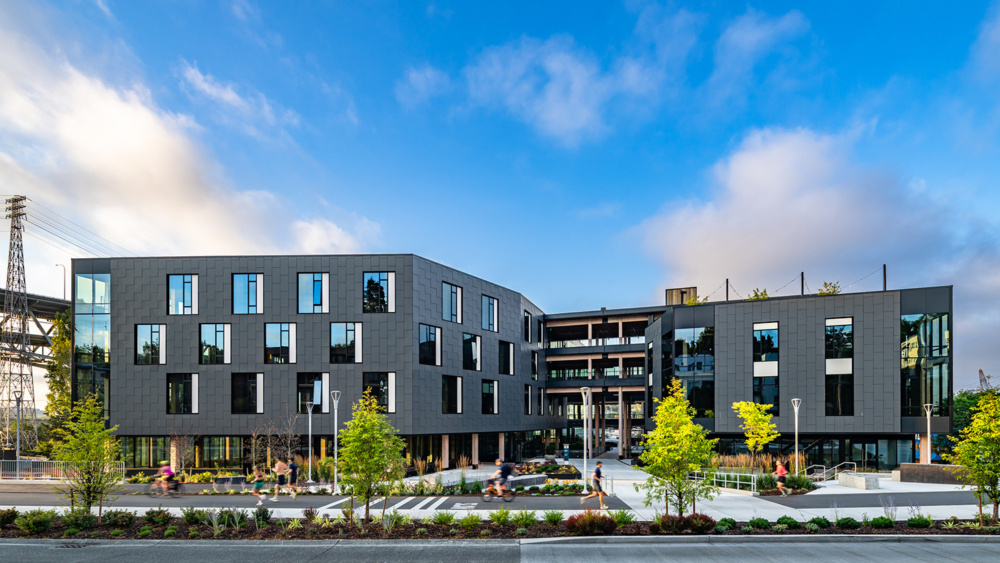
Northlake Commons blends an ambitious program of lumber warehousing, retail, restaurants, lab and office use, a public park, a regional stormwater treatment system, and 64,500 SF of multi-level outdoor space.
Northlake Commons blends an ambitious program that includes lumber warehousing, retail, restaurants, lab and office use, a public park, a regional stormwater treatment system, and 64,500 SF of multi-level outdoor space. A LEED Platinum development, the project is centered on human experience and ecosystem health, evoking the comforts of home, connections to nature, and deep green strategies.
The landscape serves to immerse people in a colorful, vibrant environment that inspires creativity and innovation derived from connection to the natural world. Overlooking swaths of perennials and understory plants, a series of outdoor spaces allows visitors to experience the site from multiple levels. The project evokes drama and emotional resonance as you approach from all edges.
A Neighborhood Amenity
The project is located between the transforming Northlake maritime neighborhood to the south and the single-family Wallingford community uphill to the north. From the north, the 27-mile Burke-Gilman Trail intersects with the building’s public plaza and park space. The site welcomes trail users with a mix of retail and open space that bisects the building and frames a stunning view of Lake Union and Downtown Seattle.
A meandering pathway through the project takes visitors through a series of spaces that emphasize the multilevel nature of the site. A bridge experience over a forest floor garden creates the feeling of walking through a grove of trees. A central courtyard anchors the core of the building and is a gathering space that connects indoors to outdoors within the building’s office spaces. The path angles and culminates with an overlook and a connection to a greenspace where the building’s footprint was intentionally held back from the 200-foot Lake Union shoreline buffer. The greenspace integrates a regional bioswale that cleans 2.6 million gallons of neighborhood stormwater runoff annually. The design provides a public through-block connection from the trail to the shore.
Building a Community Park
In collaboration with the Seattle Parks and Recreation Department, the project elected to transform underutilized land beyond the property line into a new public park that strengthens the connection to the Burke- Gilman Trail. The new open space serves as a midway respite along the trail between Fremont and the University of Washington. With tiered seating, bike air and water stations, and a cafe, the park provides a place to stop, have a cup of coffee, and connect with the community. Historically, it’s been uncommon for the Parks Department to coordinate space with private development in this way. However, the success of this park demonstrates the urban design benefits of public-private partnerships and has paved the way for similar improvements along the Burke-Gilman Trail system.
Biophilic Design
The project’s design intersects three core values: health, beauty, and performance, manifested through biophilic principles. Embodying the experience of being deep within a Pacific Northwest Forest, the biophilic design concept expresses the distinct layers of a forest floor, understory, and canopy. The plant palette echos the many environments of the forest with open meadows, a sheltered clearing, and an edge environment where water and life converge.
The diverse plant species throughout the landscape support nearby animal habitats and connect to an extensive neighborhood “pollinator pathway.” Visible stormwater systems and educational signage (highlighting bioswales and pollinators) invite the community to reflect on how we can be better stewards of the environment.
Cleaning Stormwater
Leveraging the significant 30-foot grade change between the site’s north and south edges, the project sought to intercept pollution before it reaches the nearby urban waterways. The project installed a diverter structure that allows over 100 gallons/min to bypass the otherwise conventional storm pipe within the street and make its way onto the private property. The water traverses a vortex filter, a treatment vault, and a series of open runnels that culminate in a vegetated bioswale surrounded by a naturalized area of perennials for pollinators. Mimicking the ecological function of a forest, the regional bioretention system slows and filters stormwater runoff, scrubbing toxins as the runoff seeps through the bioswale’s soil and plantings. From here, the clean filtered water rejoins the below-grade storm infrastructure in the public right-of-way and then flows into Lake Union.
By sending treated stormwater into Lake Union, the bioswale reverses the detrimental impacts of polluted runoff. The project supports water quality and aquatic ecology by protecting numerous species, including salmon, a crucial keystone species of the Puget Sound. Protecting salmon also benefits local Orca pods, which are dependent on healthy salmon populations for survival.
A New Model for Private Developments
Northlake Commons is the first project to receive Seattle Public Utilities’ (SPU) Beyond Code Incentive. It defined a new stormwater management framework for SPU that partners with private developments to treat public stormwater beyond site-specific code requirements on private property. Northlake Commons satisfies the onsite stormwater mitigation requirement by treating roadway runoff, which is far more polluted than typical rooftop runoff.
A precedent set on a previous project that cleaned bridge runoff led the team to pursue a similar approach by accessing a large storm pipe consolidating roadway runoff uphill from the site. The project served as a test case for rulemaking within SPU to remove barriers for future partnerships. An evaluation of cost and infrastructure system benefits resulted in a pathway to reimburse private developers that elect to clean right-of-way water on private property.
Cleaning more than twice the volume of stormwater runoff required by code, Northlake Commons created a replicable model and helped SPU define a legal, permitting, and operational process for partnering with new developments. This partnership leverages the installation of on-site stormwater infrastructure to include the treatment of public stormwater as well.
As Seattle continues to grow and experience the impacts of heavy rainfall due to climate change, redeveloping underutilized sites and addressing pollution on a city-wide scale will help unburden the city’s infrastructure. Early city planners viewed waterways as the eventual outfall of precipitation, and as a backup for sewage infrastructure. These stormwater systems become inundated due to the construction of new buildings and hardscapes. Overflowing sewage and flooding negatively impact regional water quality and can cause beach closures. Northlake Commons illustrates a shift in the approach to private development, where new construction can contribute to a healthy regional watershed, not only providing environmental benefits but rewarding developers, building tenants, the city, and the public.
“Northlake Commons exemplifies what’s possible when developers and designers prioritize creating public spaces that serve the community in a holistic way. The bioswale not only meets stormwater code requirements—it exceeds them, functioning as a regional stormwater facility while offering habitat for birds and butterflies and a restorative space for people. This project allowed Seattle Public Utilities to pilot an innovative incentive program, and the team stands out as rare, consistent community partners who make change possible.”
– Nicole Kistler, Seattle Public Utilities Green Stormwater Infrastructure Policy and Partnerships Lead