
By Kristen Scott
Kristen Scott is Managing Partner and Senior Principal of Weber Thompson where she heads the Workplace studio. As Managing Partner of Weber Thompson for more than 25 years, she has overseen the growth of the firm from its beginnings to the sustainably focused 60 person multi-disciplinary firm it is today.
Read Part 1 of this article featuring The Terry Thomas here.
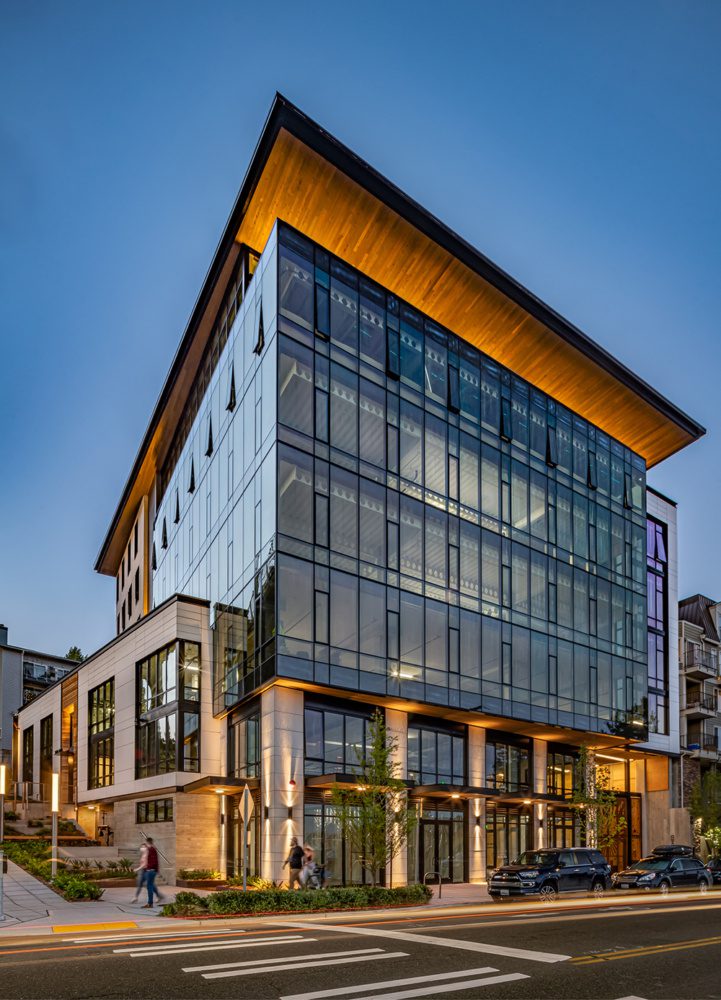
Watershed, Seattle, WA (Photo by Built Work Photography)
Part 2: Watershed
In 2016, we started the design of Watershed working with the same clients as The Terry Thomas and were able to utilize a new incentive program, Seattle’s Living Building Pilot Program. This program gives additional height and area in exchange for meeting aggressive energy and water reductions as well as three petal certification from ILFI’s Living Building Challenge. Many of the lessons from The Terry Thomas about daylighting and energy are applied to Watershed’s design, but the main story is focused on water conservation and ecological restoration.
A Challenging Site with Big Opportunities
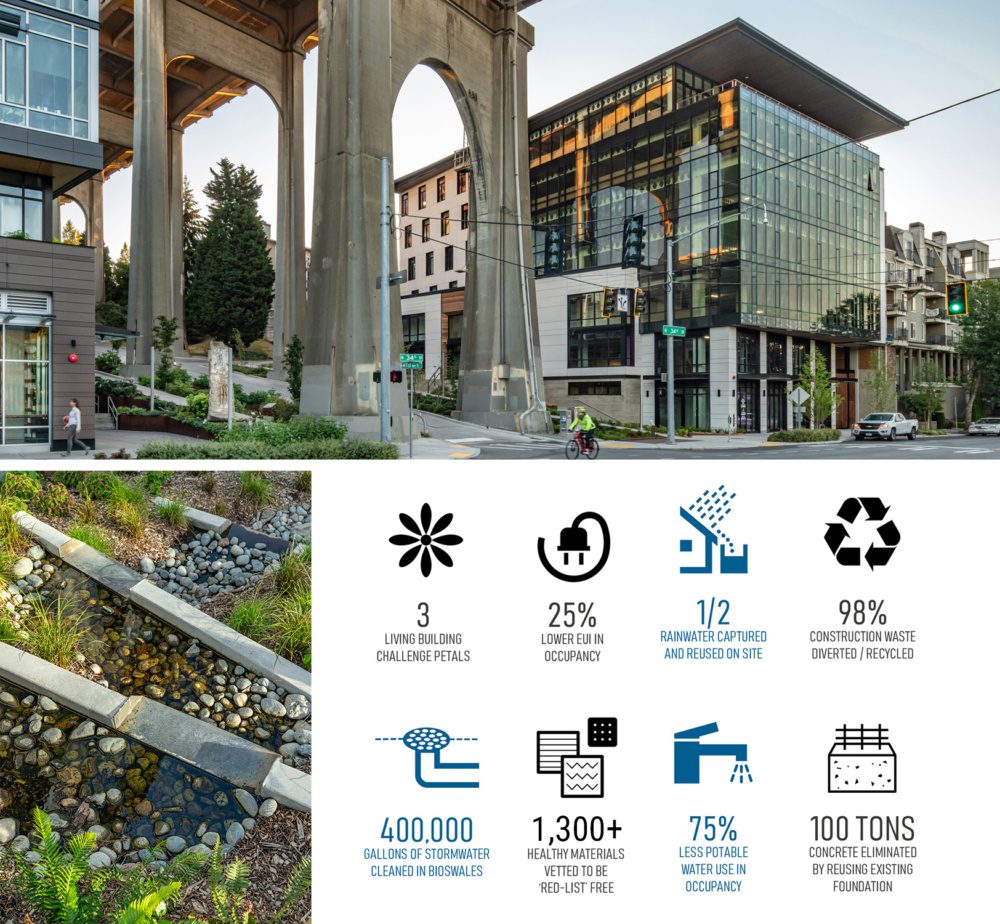
Located under the Aurora Bridge, toxic stormwater runoff was flowing straight into Lake Union below, polluting a major salmon migration route. Researchers at the University of Washington had completed studies showing how the runoff was killing salmon and determined that tire dust from the traffic on the bridge was the main culprit.
Given a very large, underutilized right of way (ROW) below the bridge, we saw an opportunity to treat the stormwater, create a public open space and share the story of improved ecological health with the community.
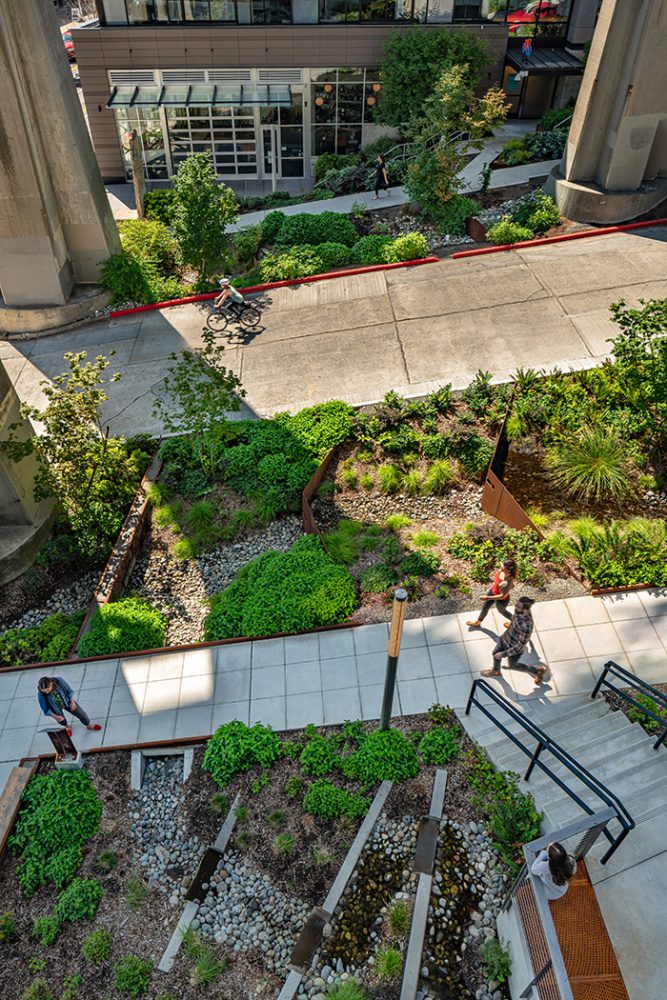
Phase 2 of the Aurora Bridge Bioswales located outside of Watershed (Photo by Built Work Photography)
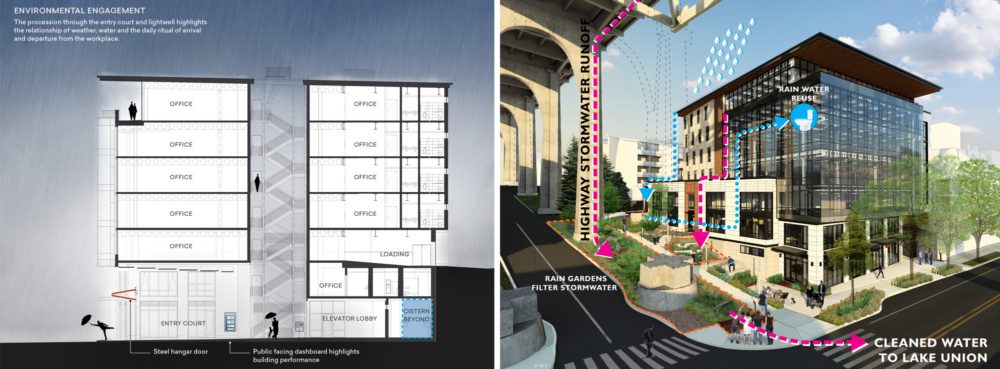
By working closely with Seattle Public Utilities (SPU) and Seattle Department of Transportation (SDOT), we designed a series of privately funded and maintained bioswales in the public ROW to clean hundreds of thousands of gallons of polluted public stormwater runoff. This work inspired our client to start a non-profit, Clean Lake Union to clean more stormwater. It also led SPU to establish a program to help fund and support other private development that takes significant amounts of public stormwater onsite to clean it.
Design for Water Capture and Reuse
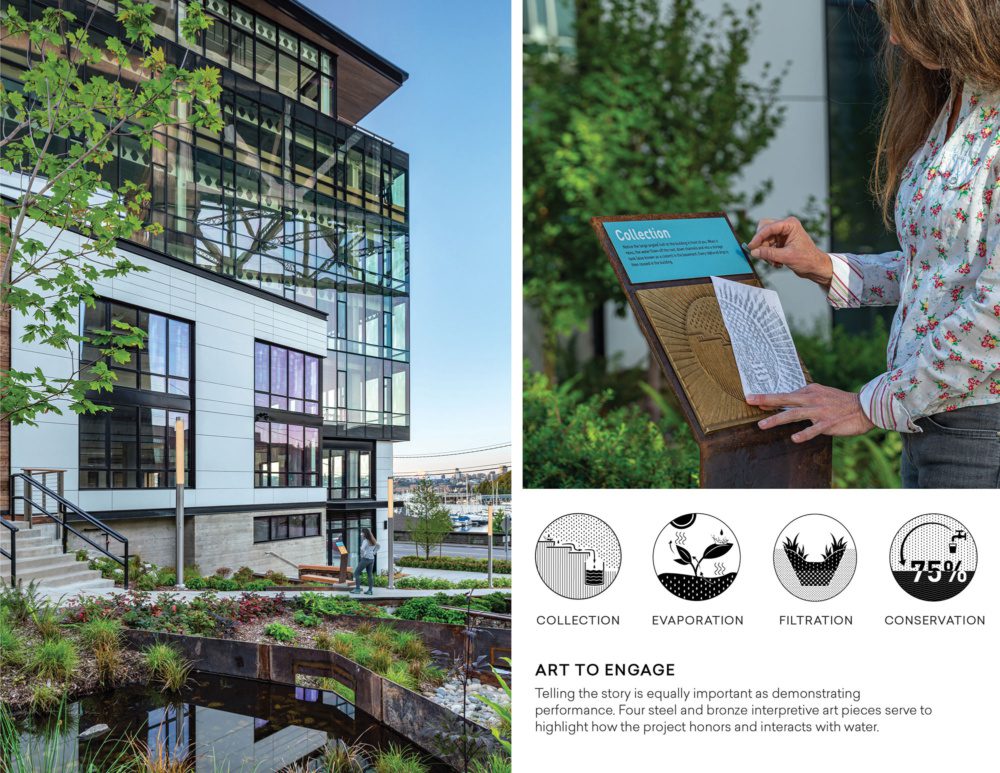
The shape of the building with a shed roof directing rainwater to a 20,000 gallon cistern for reuse in irrigation and toilet flushing results in Watershed using 88% less water than a baseline office building. A sculptural gutter system and a vertical art piece makes the path of the water visible to passersby as it flows down into a subgrade cistern.
Natural Systems and Connection to Nature
Lushly planted bioswales frame a series of terraces, providing respite with a shady place to sit outside. Signage explains the story of water onsite and how it parallels a natural predevelopment system of collection, filtration, evaporation, and conservation.
Energy Efficiency Side Note
In the intervening years, HVAC equipment and lighting systems have become much more efficient as well as new technological advances in glazing and wall system design. In contrast to The Terry Thomas, with no AC and a measured 37 EUI, Watershed has a complete HVAC system: an efficient Variable Refrigerant Flow (VRF) system with a Dedicated Outdoor Air System (DOAS) for fresh air and still achieves a very low 28 EUI at full occupancy.
Biophilic Design in Action
Our biophilic connection to natural systems is at the core of the design of both projects. By letting natural ventilation and daylighting drive the massing of The Terry Thomas, we arrived at the square donut shape and our beautiful outdoor courtyard.
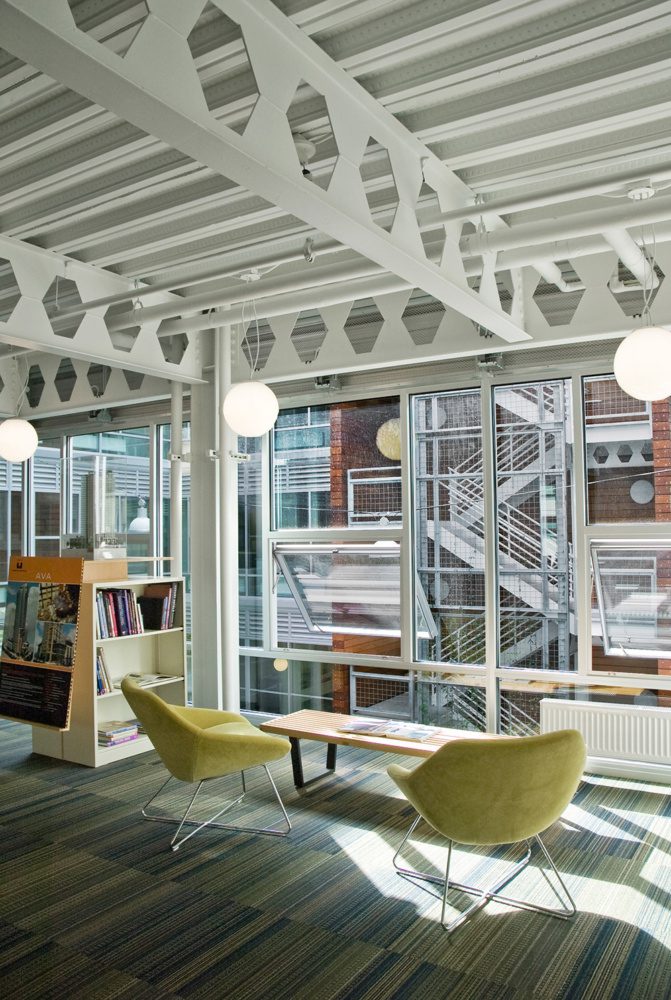
The Terry Thomas, looking into the courtyard
By allowing water conservation to shape the design concept of Watershed, it led us to a dramatic shed roof to capture water and an exterior lobby and stair to emphasize the connection to the environment. The series of landscaped outdoor spaces and stepping bioswales connecting multiple levels of the building give everyone a chance to connect with the neighborhood and nature, while directly experiencing water conservation and ecological resilience.
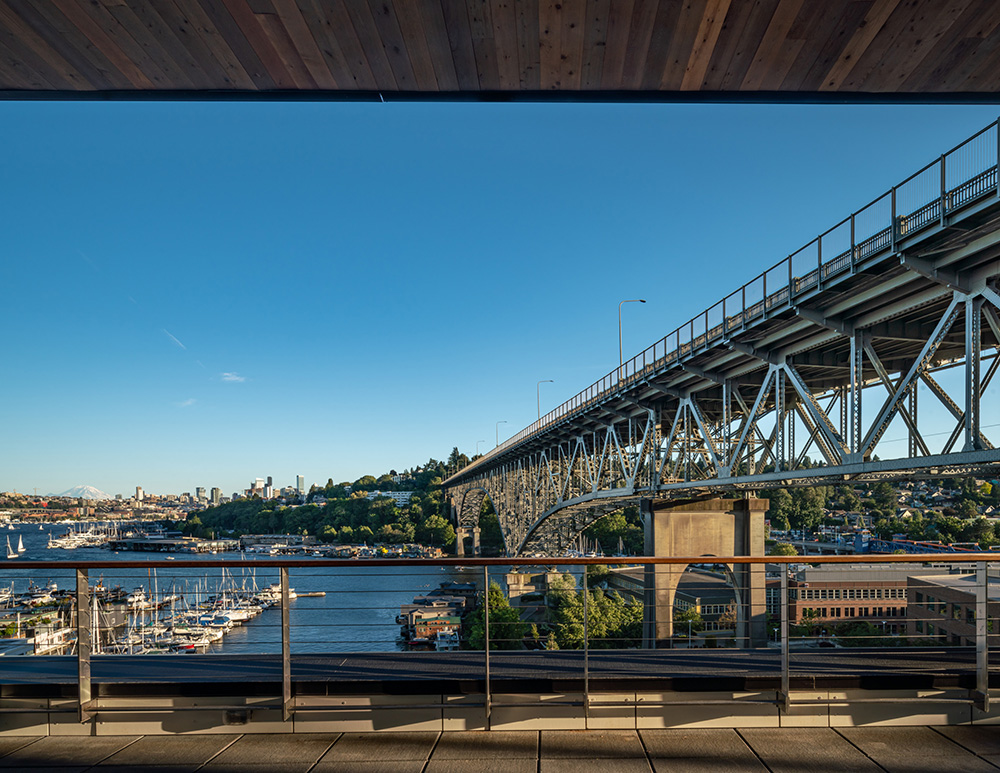
View from Watershed (Photo by Built Work Photography)
Designing buildings to mimic natural systems where possible not only minimizes their impact but in the best cases, helps improve and heal the ecological health of the surrounding environment.