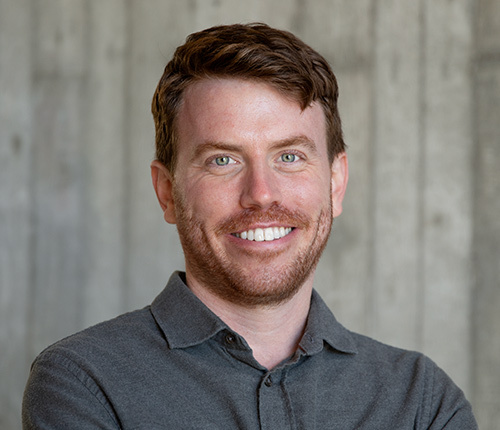
By Benjamin Hait
Since joining Weber Thompson in 2025, Benjamin Hait has served as a Senior Project Architect, advancing the design and technical resolution of high-density housing and mixed-use projects. His perspective, shaped by the lived experience of growing up with a Deaf brother, informs a professional focus on how the built environment influences communication, access, and everyday interaction. He brings a focus on clarity, material intelligence, and constructible design strategies.

On April 7, I had the privilege of chairing an office-wide workshop titled “The Architecture of Communication: A Celebration of Identity & Narrative.” The session was designed to move beyond the abstract and challenge our project teams to treat connection as a deliberate result of creative intention rather than a passive default. By exploring the intersection of Deaf history with the built environment, we fostered a deeper awareness of the sensory experiences of Deafness and their implications for design.
The Evolution of Accessibility: Social vs. Medical Models
In leading this conversation, I turned to the evolution of accessibility and how Deaf history is shaped by a shift in perspective: from the medical model of disability, which historically localized the “problem” within the individual, to the social model, which instead recognizes that the built environment itself constitutes a barrier.
The Americans with Disabilities Act (ADA) of 1990 was pivotal in this transition, mandating “effective communication” as a matter of civil rights. This legal framework integrated essential life-safety features, such as visual notification and assistive listening systems, into standard building codes. However, it also provided the necessary foundation for more nuanced spatial theories of access, most notably DeafSpace a design framework developed by researchers at Gallaudet University that treats the Deaf experience as the generative logic of design, rather than an afterthought.
The Tectonic Principles of DeafSpace
Our discussion then led to the tectonic principles of DeafSpace, an unapologetic expression of the integrity of the Deaf experience. Drawing from Gallaudet’s DeafSpace Design Guidelines, I led our team through an analysis of five specific spatial parameters:
- Sensory Reach: Maintaining unobstructed sightlines to facilitate visual cues and signing.
- Space and Proximity: Designing wider corridors and “eddy” spaces to accommodate the physical “signing circle” required for comfortable, mobile conversation.
- Mobility: Implementing low rise-to-run stairs and clear circulation paths to allow signers to maintain eye contact while in motion.
- Light and Color: Utilizing balanced, low-glare lighting and high-contrast, muted palettes to reduce eye strain and sharpen visual perception of hand shapes.
- Acoustics and Vibration: Managing reverberation to minimize “visual noise” and employing vibratory floors to provide haptic notification of approaching occupants.
We examined these principles through contemporary precedents, including LTL Architects’ Gallaudet University Residence Hall and Mithun’s recent work for the Washington School for the Deaf (WSD).

The Spatial Logic of ASL
A portion of the session focused on the linguistic structure of American Sign Language (ASL). ASL is a distinct, visual-spatial language with a syntax and grammar entirely independent of English. One intersection between language and spatial thinking lay in the use of ASL Classifiers. These handshapes function as pro-forms to describe how an object exists or moves in space. For architects and designers, this mirrors the process of communicating visually through sketching—using hands rather than pens. During the workshop, we used classifiers to visually “construct” the geometry of several Seattle landmarks: the slender verticality of the Space Needle, the interlocking volumes of the Amazon Spheres, the tapered concrete plinth of the Rainier Tower, and the cantilevered platforms and faceted massing of the Seattle Central Library.
Continuing the Journey
This session marks an ongoing commitment at Weber Thompson to create more inclusive, communicative spaces. I encourage the broader design community to engage with these resources:
- Language Acquisition: Pursue ASL coursework with Deaf educators through the virtual classes at the Sign Language Center in NYC, or through Gallaudet University’s ASL Connect program. A more informal resource is “The ASL App” on available iOS and Android.
- Cultural Engagement: Support authentic Deaf representation through local events in the Pacific Northwest such as the Seattle Deaf Film Festival and Seattle Deaf Literary Festival organized by nonprofit Deaf Spotlight.
By analyzing the sensory ecologies of DeafSpace and the visual richness of ASL, we advance our ability to design environments that are accessible and equitable in ways not yet imagined.